
Holy Family Catholic Primary School Live together, work together, pray together
SEND Report
Roles and Responsibilities
SEND Co-ordinator - Miss Ashcroft
Responsible for:
- Coordinating all the support for children with special educational needs or disabilities (SEND), pupil premium, children looked after and safeguarding and developing the school's SEND Policy to make sure all children get a consistent, high quality response to meeting their needs in school.
Ensuring that you are:
- involved in supporting your child's learning
- kept informed about the support your child is getting
- involved in reviewing how they are doing
-
Liaising with all the other people who may be coming into school to help support your child's learning e.g. Speech and Language Therapy, Educational Psychology etc.
-
Updating the school's SEND register (a system for ensuring all the SEND needs of pupils in this school are known) and making sure that there are excellent records of your child's progress and needs.
-
Providing specialist support for teachers and support staff in the school so they can help children with SEND in the school achieve the best progress possible.
Class teacher
Responsible for:
- Checking on the progress of your child and identifying, planning and delivering any additional help your child may need (this could be things like targeted work, additional support) and letting the Inclusion Manager know as necessary.
- Writing Individual Education Plans (IEP), and sharing and reviewing these with parents at least once each term and planning for the next term.
- Ensuring that all staff working with your child in school are helped to deliver the planned work/programme for your child, so they can achieve the best possible progress. This may involve the use of additional adults, outside specialist help and specially planned work and resources.
- Ensuring that the school's SEND Policy is followed in their classroom and for all the pupils they teach with any SEND.
Headteacher - Mrs Roberts
Responsible for:
- The day to day management of all aspects of the school, this includes the support for children with SEND.
- Delegating responsibility to the Inclusion Manager and class teachers but still responsible for ensuring that your child's needs are met.
- Keeping the Governing Body up to date about any issues in the school relating to SEND.
SEN Governor
Responsible for:
Making sure that the necessary support is made for any child who attends the school who has SEND.
How does the school know if a child needs extra help?
The four areas that can affect a child's ability to learn are categorised as:
- Communication and interaction
- Cognition and learning
- Social, emotional and mental health difficulties
- Sensory and/or physical needs
Some children may enter school with a complex physical or medical need identified by the local authority. These children will have an Education Health Care Plan.
For all children we use our ongoing assessment for learning strategies and termly pupil progress meetings to discuss and monitor each individual pupil's progress and attainment.
All assessments seek to identify pupils making less than expected progress given their age and individual circumstances. This can be characterised by progress which:
- is significantly slower than that of their peers starting from the same baseline
- fails to match or better the child's previous rate of progress
- fails to close the attainment gap between the child and their peers
- widens the attainment gap
- It can include progress in areas other than attainment
Children will be given support according to their need. It will be characterised by some children needing 'some support'; 'lots of support': or 'extensive support'. Parents/ carers will be informed about any support your child receives (this will be at parents evening)
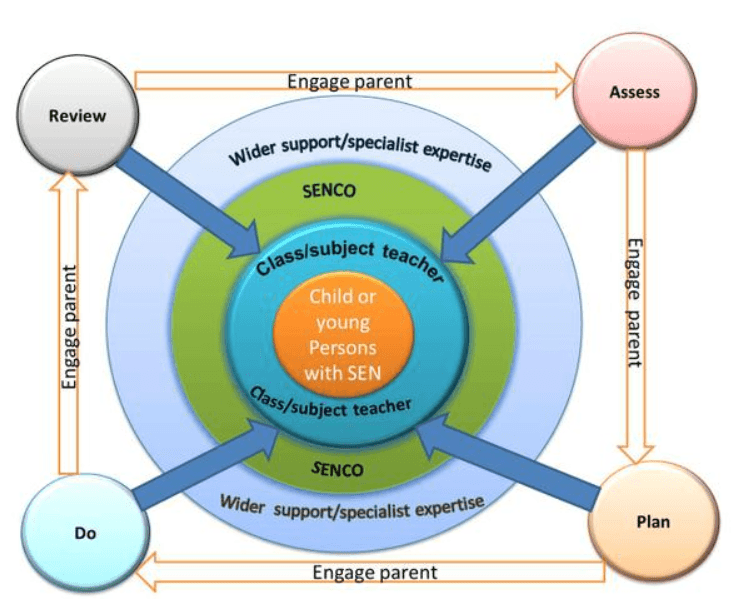
All support will follow a cycle of Assess-Plan-Do-Review and will provide information about your child and their barriers to learning. Where interventions or booster sessions have not had significant impact, children may require ongoing level of 'some support' or to progress onto 'lots of' or 'extensive support'. This will be decided upon by using assessments will be made to decipher, what are the barriers to learning and agencies may be called upon.
A Individual Education Plan (IEP) will be completed with the SENCo, class teacher and parent/carer, to set SMART targets to enable an evaluation of your child's needs and the best support needed. It is important that you attend meetings around the IEP as your input is valuable on meeting the needs of the child.
At Holy Family, social and emotional mental health (SEMH) is extremely important for all our children. Concerns from teachers and / or parents related to SEMH needs, can be raised with the class teacher, SENCo or the Headteacher. Some children may access the learning mentor for sessions to work on self-esteem, friendships, anger management and attachment issues. Referrals for counselling and other agency support can be accessed for those with severe mental health issues.
Children will be identified as having a SEN using the Code of Practice (2014), where their learning difficulty or disability is severe and calls for special educational provision, namely provision different from or additional to that normally available to pupils of the same age, requiring 'lots of support'. This will mean that your child is placed on the schools SEN register.
Teachers and staff can raise concerns at any point with the schools SENCo Miss Ashcroft
What should I do if I think my child has a special educational need?
- In the first instance you should discuss any concerns you have with your child’s class teacher. Your child’s class teacher will take your concerns seriously and as part of normal class work will differentiate the curriculum and make reasonable adjustments to help your child.
- If your child has not made the expected progress with these adjustments then a meeting will be arranged with yourself, the class teacher and the school’s SENCo (Miss Ashcroft). Your child will also be involved in some of these discussions in order to involve them fully in their learning. Targets and plans to achieve them will be agreed and a date to review the progress made will be set .
- Some children may need more complex arrangements and in that case the Headteacher, Mrs C Roberts or Deputy Headteacher, will be involved in the discussions about the provision we can make for your child.
- Your child’s difficulties may require a high level of support and/or specialised programmes that the school may not be able to resource on its own. In these circumstances the school may be able to apply for ‘top-up’ funding from the local authority.
- For some children an Educational Health Care plan may be appropriate. This can be requested by the school or parent/carer. Many professionals would be involved in an EHC.
- If, despite our best endeavours, you are not happy with the provision we are able to make for your child then your concerns should be directed in writing to; Mr Michael McDonald , Chair of Governors, at the school address.
How do we identify children with SEN and assess their needs?
We have a policy of striving towards identifying learning difficulties as early as possible.
- Children are assessed for language development during their time in Reception. This is to assess their understanding and expression of the spoken word. Early intervention is important as these skills are important for learning.
- Teachers are constantly assessing and monitoring pupil’s in their care as part of their daily work.
- Regular pupil progress meetings also help identify pupils who are not making expected progress and, therefore, require targeted support.
- Children who fail to make expected progress, despite a targeted plan, may need more specialized assessments. These are arranged through discussion with the class teacher, yourself and the SENCO. Depending on the specific need a specialised assessment may be carried out by an Educational Psychologist, TESS Teacher, Speech & Language Therapist, Occupational or Physiotherapist. Some children may need to be referred to a Paediatrician or CAMHS.
- We work closely with parents/carers to incorporate advice from other professionals into the child’s learning plan.
How will school staff support my child?
- For all children we provide ‘Quality First Teaching’ in every classroom. This means that teachers are highly skilled and have access to a wide range of resources and support to deliver lessons.
- As part of ‘Quality First Teaching’ teachers would differentiate the curriculum and make reasonable adjustments for any child who is finding learning difficult and not making the expected progress.
- If it is felt that, despite the above, a child is not making expected progress then what is known as a ‘Graduated Response’ is adopted. This is a four part cycle of assessing; planning; doing and reviewing. It draws on more detailed approaches, more frequent reviews and more specialist expertise in successive cycles in order to match learning experiences and interventions to the specific need of the child.
When is a Education Health Care Plan given?
An Education Health Care Plan is written by the authority when a request is made. A request must show that your child is in need of 'extensive support' (above that which available in the school funds), in order to access the curriculum and meet their potential. Usually your child will also need specialist support in school from a professional outside the school. This may be from:
- Local Authority central services such as the ASD Outreach Team or Sensory Service ( for students with a hearing or visual need)
- Outside agencies such as the Speech and Language therapy (SALT) Service.
For your child this would mean:
- The school (or you) can request that the Local Authority carry out a assessment of your child's needs. This is a legal process which sets out the amount of support that will be provided for your child.
- After the school have sent in the request to the Local Authority (with a lot of information about your child, including some from you), they will decide whether they think your child's needs (as described in the paperwork provided), seem complex enough to need a statutory assessment. If this is the case they will ask you and all professionals involved with your child to write a report outlining your child's needs. If they do not think your child needs this, they will ask the school to continue with the support at 'extensive' level
- After the reports have all been sent in the Local Authority will decide if your child's needs are severe, complex and lifelong and that they need a very high level of support in school to make good progress. If this is the case they will write an EHC Plan.
- The EHC Plan will outline the number of hours of individual/small group support your child will receive from the LA and how the support should be used and what strategies must be put in place. It will also have long and short term goals for your child.
- An additional adult may be used to support your child with whole class learning, run individual programmes or run small groups including your child.
This type of support is available for children whose learning needs are:
- Severe, complex and lifelong
- Need a very high level of support
How will I know if my child is making progress?
- Although a child with SEN may not progress in line with their peers, all children should make progress from their unique starting point. This is then a clear indication that the provision is working.
- Your child’s progress will be discussed at the termly meetings with your child’s teacher as part of our graduated response. (See ‘Our approach to teaching children with SEN).
- Our school data tracking systems enable us to analyse data quickly and we can monitor whether a child is making progress and also the rate of progress.
What support and training will be available?
- The school works closely with the Local Authority to identify and provide training for staff.
- Termly pupil progress meetings allow us to identify what support the school needs to offer.
- We have skilled and experienced staff able to deliver a wide range of intervention programmes including; Better Reading, Communication Keys, Maths Recovery, Sounds Write and Reading between the lines.
- Interventions are targeted at specific individuals and monitored and evaluated regularly.
- We work closely with and undertake training from a range of other professionals as and when necessary throughout the year.
- The Headteacher and SENCo both hold the NASEN qualification.
What specialist services and expertise are available at or accessed by school?
How do we enable children with SEN and/or a disability to engage in all of our activities?
Pupils with medical needs -
- Detailed care plans are compiled with support from the school nurse/specialist nurse in consultation with parents or carers.
- On-going training is delivered by an appropriate health professional e.g. diabetic nurse, cystic fibrosis nurse, epilepsy nurse.
- Where necessary and in the agreement with parents/carers and health professionals medicines can be administered in school. A signed medicine consent form is required to be signed.
- All staff are trained in first aid.
- We have staff trained paediatric first aid.
How accessible is the school environment?-
- We have an ‘anticipatory’ duty of care and work closely with health and educational professionals, parents/carers to accommodate a pupils needs and ensure a smooth transition to our school.
Including all children in activities outside the classroom, including school trips.
- Risk assessments are carried out and procedures are put in place to enable all children to participate. However, if it is deemed that an intensive level of support is required then a parent/carer may be asked to accompany their child.
How will school support transitions for my child?
Transition to a new class or key stage within school:
- There are opportunities for all children to visit their new classroom and class teacher. Some children may require extra visits to familiarise themselves and ease any anxieties.
- Certain children may need a carefully thought out and individualised transition plan. This will involve working closely with parents/carers in order for the preparation to continue over the summer holidays e.g a book with pictures of the new classroom and members of staff working with the child.
- Detailed information sharing between teachers takes place during these important transition times.
Transition between Year 6 and Year 7
- Close liaison/discussion takes place between primary and secondary staff to enable a smooth transition for pupils with SEN.
- Transition day visits are arranged. The number of transition visits that are arranged will depend on the individual child.
- A child with an Education Health Care Plan in place will have a detailed transition plan. This will ensure that the most appropriate provision is in place. These transition plans will be formulated during a multi-agency meeting.
- In some cases, usually when an EHC is in place, a member of staff from school will accompany a child on their preliminary visit to their new school.
- All records are shared with the new school and passed on as soon as possible.
Wigan Council SEND Local Offer
If you have any concerns about something you see online, you can visit CEOP Safety Centre and make a report directly to CEOP by clicking the button below